
What Measurements Do You Need for a Floor Plan?
A clear checklist of every measurement to record so your sketch can be redrawn into an accurate floor plan — walls, doors, windows, stairs, cupboards and ceiling heights.
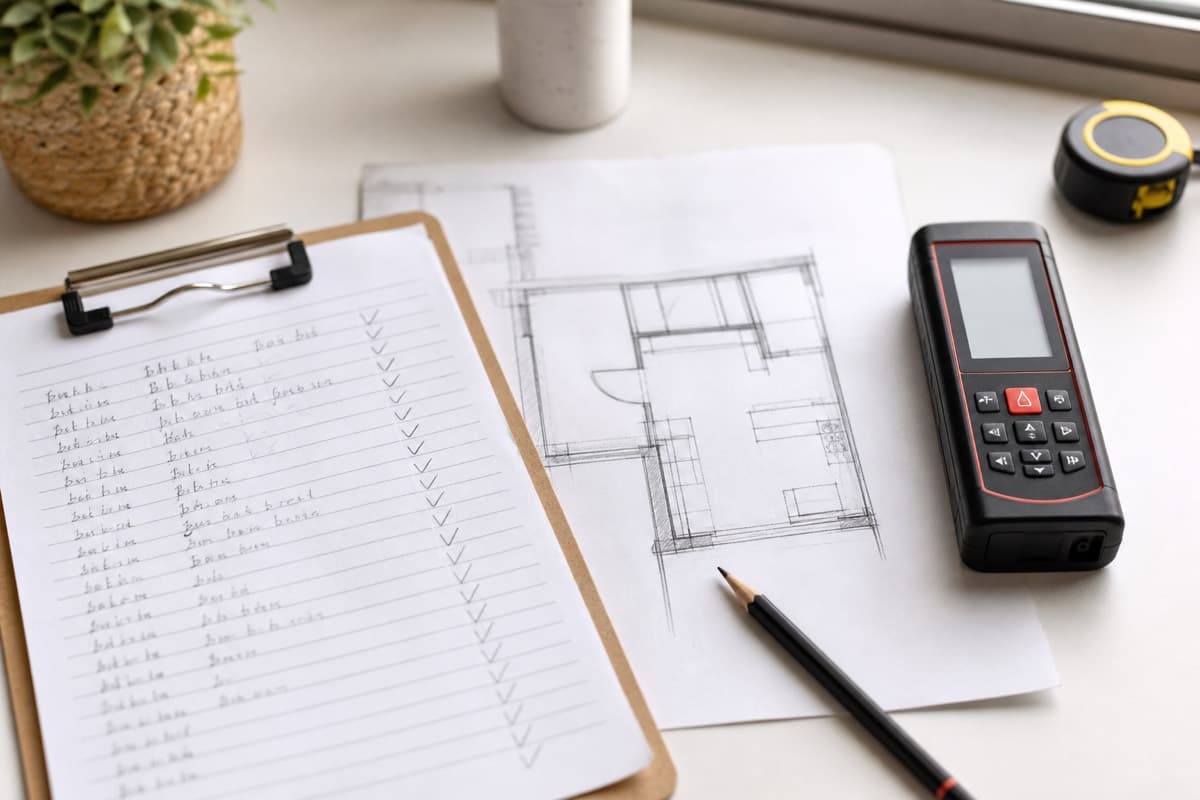
What measurements do you need for a floor plan?
For a floor plan you need the length of every wall in each room, the width and position of doors and windows, the staircase run and width, the size and position of built-in cupboards, and ceiling heights if they matter for your notes. Record everything in metres and check that opposing walls in each room add up.
Key takeaways
- Measure every wall length in each room, in metres.
- Record the width and position of doors and windows.
- Capture the staircase run, width and direction.
- Note built-in cupboards, wardrobes and chimney breasts.
- Add ceiling heights if they matter for your notes.
- Cross-check opposing walls so totals agree before you upload.
A floor plan is only as good as the measurements behind it. You do not need surveying equipment or training — a tape measure or a cheap laser measure, a pencil and a clear method are enough. This checklist covers everything to record so your sketch can be redrawn into an accurate, professional floor plan.
Ready to turn your sketch into a floor plan?
Upload your hand-drawn sketch and measurements and our team will redraw them into a clean, professional floor plan — ready for listings, brochures and marketing.
Wall lengths
Measure the length of every wall in every room. Work clockwise from the same corner each time so you do not skip anything. Write each measurement directly onto your sketch next to the wall it belongs to.
In a rectangular room, the two opposite walls should be the same length. In more complex rooms, the sum of the segments on one side should equal the sum on the opposite side. This simple cross-check is the fastest way to catch a mistake before it reaches the drawing.
Doors and windows
For each door and window, record:
- The width of the opening
- Roughly how far it sits from the nearest corner
- For doors, which way they open (a small arc on your sketch is perfect)
You do not need to be precise to the millimetre — a note like "window 1.2m, about 0.5m from the corner" gives us everything we need.
Stairs
Staircases are easy to oversimplify and important to get right, especially in flats, maisonettes and houses over several floors. Record:
- The overall run (length) of the staircase
- The width between the walls or banisters
- The direction (mark an "UP" arrow)
If the stairs turn, sketch each flight and landing.
Built-in storage and fixed features
Anything built in counts towards the usable space and should appear on the plan. Note the position and size of:
- Built-in wardrobes and cupboards
- Airing and utility cupboards
- Chimney breasts and alcoves
For fitted kitchens, you do not need to measure every unit — just mark the run of units and note the sink, hob and any appliances.
Ceiling heights (optional)
For a standard marketing plan you can skip ceiling heights. If ceiling heights matter for your notes — for example a loft room or sloped ceiling — note the height in each room and the point where any sloped ceiling drops below head height. Sketchplan drawings are for listings and marketing, not planning applications.
Print the free template
Our sketch template is printable graph paper with a built-in measurement checklist — sketch on it, photograph it, and upload it. It keeps everything in one place so nothing gets missed.
Common measurement mistakes
- Forgetting the stairwell void on upper floors — it is not a room and should be shown as open.
- Measuring to the skirting board instead of the wall — be consistent.
- Missing alcoves and chimney breasts, which throws off the room totals.
- Not cross-checking opposing walls before leaving the property.
For more on this, see common floor plan measuring mistakes.
What happens next
Once you have your sketch and measurements, upload them to Sketchplan. Our team redraws everything into a clean, professional floor plan with rooms, dimensions and labels, and returns it ready for listings, brochures and marketing. If anything is unclear, we will ask before we finish. One round of amendments is included after the initial draft.
Ready to turn your sketch into a floor plan?
Upload your hand-drawn sketch and measurements and our team will redraw them into a clean, professional floor plan — ready for listings, brochures and marketing.
- #floor plan measurements
- #how to measure a floor plan
- #floor plan from measurements
Frequently asked questions

The Sketchplan Team
Floor Plan Specialists
The Sketchplan team redraws hand-drawn sketches and measured notes into clean, professional CAD-style floor plans for estate agents, landlords, homeowners and property photographers across the UK.
Ready to turn your sketch into a floor plan?
Upload your hand-drawn sketch and measurements and our team will redraw them into a clean, professional floor plan — ready for listings, brochures and marketing.
Order on sketchplan.rehub.studio · see how it works
Keep reading
Related guides

Floor Plans for HMO and Room Lets
How landlords and agents use floor plans for HMO licensing, room-by-room marketing and inventories — and how to produce one from a sketch.

How Estate Agents Get Floor Plans Without a Surveyor Visit
How UK estate agents produce listing-ready floor plans without booking a measured survey — sketch at the viewing, measure carefully, redraw remotely.
How to Label Rooms and Dimensions for Portal Listings
Practical rules for room names, dimensions and abbreviations on marketing floor plans so Rightmove and Zoopla listings stay clear and consistent.